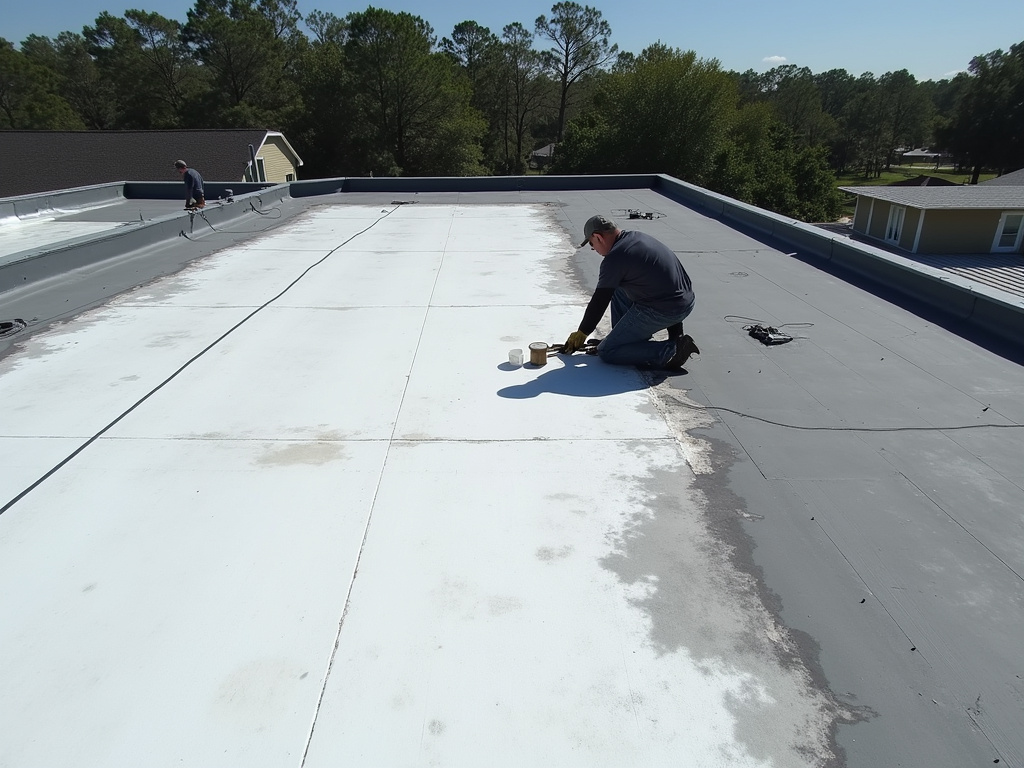
Jacksonville's humid subtropical climate brings frequent heavy rains and high moisture that quickly expose weaknesses in flat roofs on commercial buildings and certain homes in areas like Riverside and San Marco. Older housing stock from the mid-20th century often features built-up roofing or modified bitumen systems that develop blisters when trapped moisture expands during hot summers. Proper repair requires identifying the exact membrane type and addressing underlying deck issues before applying compatible patches or coatings.
Drainage problems are common near the St. Johns River where flat lots and poor original grading allow water to pond. In neighborhoods such as Arlington and Mandarin, we see repeated failures around scuppers and drains that were never sized for the region's storm intensity. Technicians must check for code-compliant slope corrections and use reinforced flashing at all penetrations to prevent recurrence during mild winters when condensation adds extra stress.
Flat Roof Repair Near You — Choose Your City
Every city below has its own local Flat Roof Repair page with coverage details.
Repairs in Duval County also account for wind-driven rain from coastal influences in nearby Atlantic Beach and Neptune Beach. Materials like EPDM or TPO patches must be mechanically fastened or fully adhered depending on the existing system to meet local wind-load expectations. Homeowners in Springfield and Avondale frequently overlook seam separation until interior water damage appears, making early inspection critical before the next summer downpour.
Technician insight
In Jacksonville the thing that catches most people out with flat roof repair is how quickly humidity and poor drainage around the St. Johns River turn small seam failures into widespread blistering, especially on 1970s-1980s buildings in Riverside and Arlington where original slope was never adequate.
Ponding Leak in San Marco Commercial Building
Water intrusion appeared after a heavy summer rain on a modified bitumen roof. Inspection revealed clogged scuppers and seam separation along a low-slope valley. We opened affected areas, replaced saturated insulation, installed new reinforced flashing, and cleared all drains. The roof has remained dry through multiple storms.
Flat Roof Repair Services We Offer
✓EPDM Membrane Patching
Targeted cuts and splices to restore watertight integrity on rubber roofs common in Jacksonville commercial properties.
✓Modified Bitumen Repair
Torch or cold-process fixes for granular surfaced systems that blister from heat and trapped moisture in humid conditions.
✓TPO Roof Restoration
Seam welding and coating application to extend service life on reflective membranes popular in newer Duval County builds.
✓Built-Up Roofing Maintenance
Gravel removal, flood coat renewal, and cap sheet replacement for older multi-ply systems found in Downtown Jacksonville.
✓Flat Roof Drainage Cleaning
Clearing scuppers, leaders, and internal drains to stop ponding that accelerates deterioration near the St. Johns River.
✓Coating Application
Elastomeric or acrylic coatings that restore UV protection and seal minor cracks on weathered flat surfaces.
Flat Roof Repair Cost in Florida
| Service | Typical Range | What Affects It |
|---|---|---|
| Initial Flat Roof Inspection | $150–$300 | Includes moisture scan; higher for multi-story or limited-access buildings in Downtown Jacksonville. |
| Minor Membrane Patch | $400–$900 | Per affected area under 100 sq ft; price rises with membrane thickness and reinforcement needs. |
| Drainage System Service | $350–$750 | Cleaning plus minor slope correction; varies by number of scuppers and internal leaders. |
| Full Coating Application | $1.50–$3.00 per sq ft | Depends on surface prep required and coating thickness for UV and ponding resistance. |
Ranges are typical for Florida and confirmed with an exact written quote before any work starts.
How it works
- 1
Site Assessment
Walk the roof and interior to map leaks, check membrane condition, and note drainage patterns specific to the property's location in Jacksonville.
- 2
Moisture Scan
Use infrared or capacitance tools to locate trapped water beneath the membrane without unnecessary demolition.
- 3
Targeted Repair
Cut out damaged sections, install compatible patches, and reinforce seams and flashings using materials suited to local heat and humidity.
- 4
Drainage Verification
Test flow at all drains and scuppers, then adjust slope or add cricket details if ponding remains a risk.
- 5
Final Walkthrough
Review completed work with the owner and provide maintenance guidance for seasonal conditions in Duval County.
Pricing
Upfront quotes after on-site inspection; final price depends on membrane type, extent of moisture damage, and access conditions.